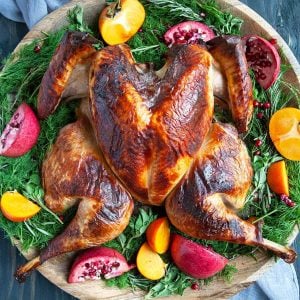
Buttermilk Brined Spatchcock Turkey (Samin Nosrat's Method) + Gravy
Spatchcock Turkey for the juiciest, simplest turkey you’ve ever roasted. The easiest, most reliable recipe for moist, juicy turkey with incredibly crisp skin.
Ingredients
For the turkey:
- 1 turkey (10-14 pounds)
- 3 quarts buttermilk
- 128 grams fine sea salt about 7 tablespoons
For the gravy:
- 6 cups chicken broth divided, plus extra as needed
- Turkey neck and giblets heart and gizzard
- Turkey backbone
- Turkey trimmings fat and skin, cut into ½-inch pieces (⅓ cup)
- 1 onion chopped
- 1 carrot chopped
- 1 rib celery chopped
- 8 sprigs fresh parsley
- 2 sprigs fresh thyme or pinch dried thyme
- 2 cloves garlic peeled
- ½ teaspoon pepper
- ¼ teaspoon salt
- 4 tablespoons unsalted butter
- 5 tablespoons all-purpose flour
- ¼ cup defatted turkey drippings optional
Instructions
For the turkey:
2-3 days before you plan to roast, spatchcock the turkey:
- Put the turkey on a cutting board, breast-side down. Use poultry shears or heavy-duty kitchen shears to cut along both sides of the backbone. If your kitchen shears struggle with the backbone, a clean pair of pruning shears makes it much easier.
- Starting at either the tail or neck end, cut halfway down the spine, as close to the spine as possible, then cut down the opposing side. Turn the turkey around and cut down the other sides.
- Spread the two sides of the turkey apart and press down to flatten. You will hear some cracks and popping of the cartilage in the breast bone. Turn the turkey breast side up and press again.
- You can cut off the wing tips, the wing tips and the first joint, or just tuck them under the bird before roasting. The wing tips and first joint make a good addition to the stock for gravy. I’ve left them on because I think it makes for a prettier bird and some people at the table may like to eat the wings.
Make the buttermilk brine:
- Open a 2 gallon ziplock bag inside a large bowl. Pour in buttermilk (3 quarts). Stir in salt (128 grams, about 7 tablespoons fine sea salt). (Double-bag it in case it leaks. For less mess, stir the salt into the buttermilk first, put the turkey in the bag, then pour the buttermilk over it.)
Marinate the turkey:
- Put the turkey inside the bag. I find it easiest to hold it by the legs and put it in head first, breast facing down. Seal the bag, squeezing out as much air as possible so that the buttermilk is touching all parts of the turkey.
- Set the bag on a rimmed baking sheet and refrigerate for 48 hours, turning every 12 hours to redistribute the buttermilk.
Prepare the turkey for roasting:
- Remove the turkey from the refrigerator, and place on a baking sheet. Wipe off the excess buttermilk. Get as much off as possible so that it doesn’t burn in the oven.
- Let the turkey come to room temperature, about 2 hours, so that it cooks quickly and evenly. (Samin lets hers sit for 3 hours, but the USDA's rule is no more than 2 hours at room temperature for perishable food.)
Place turkey on rack:
- After you’ve wiped off as much of the buttermilk as you can and the turkey has come to room temperature, put the turkey on a rack on a rimmed baking sheet. Tuck the wings under the breasts if you haven’t trimmed them off.
To roast the turkey:
- Roast the turkey in the middle of a 400° oven.
- Roast until an instant-read thermometer inserted into the deepest part of the breast registers 150 degrees and the thickest part of the thigh without touching bone registers 165 degrees, about 80 to 100 minutes for a 10 to 14 pound turkey. Start checking at 60 minutes.
- Rotate the pan occasionally as needed to ensure even browning. Tent any areas that begin to brown too quickly with foil.
- Remove the turkey from the oven and let rest for 20-30 minutes before carving.
- Pour off any collected juices and pass them through a fine mesh strainer if you’d like to add them to your gravy. Skim off any excess fat.
- You can serve the turkey whole and carve it at the table, or carve it up and serve it already sliced.
For the turkey stock:
- In a Dutch oven, simmer the turkey parts, including the trimmings (⅓ cup), with chicken broth (2 cups). Let it simmer until all of the liquid evaporates and the trimmings begin to sizzle, about 20 minutes. Continue to cook, stirring frequently, until a brown coating of fond forms over the bottom of the pan, about 2-4 minutes.
- Add the chopped onion (1), carrot (1), celery (1 rib) and garlic (2 cloves) and sauté for a few minutes until softened. If the fond seems to be darkening too much, add a few spoons of water and scrape the bottom of the pan with a wooden spoon to dissolve it while you continue to sauté the vegetables.
- Add the rest of the chicken broth (4 cups), along with the parsley (8 sprigs), thyme (2 sprigs), salt (¼ teaspoon) and pepper (½ teaspoon). Simmer for 1-2 hours.
- Strain stock through a fine meshed sieve. You should have about 4 cups of turkey stock. The stock can be refrigerated for up to 2 days.
To make the turkey gravy:
- In a medium saucepan, melt the butter (4 tablespoons) over medium heat. Add the flour (5 tablespoons) and increase the heat to medium-high, stirring constantly, until the mixture turns a deep golden brown. Whisk in the turkey stock (about 4 cups) and bring to a simmer. Simmer until thickened, about 5 minutes. Stir in any drippings (¼ cup), if using, and salt and pepper to taste.
- The gravy can be refrigerated for up to 3 days or frozen. To thaw, reheat gently over low heat. Stir in extra broth to thin as necessary.
Notes
- Samin calls for marinating the turkey for a full 48 hours so the flavor has time to permeate the whole bird. In a hurry, I’ve only marinated it for 24 hours and every bite was juicy and flavorful.
- Roasting time: About 80 to 100 minutes at 400°F for a 10 to 14 pound turkey, roughly 7 minutes per pound (10 pounds: about 70 to 80 minutes; 12 pounds: about 80 to 90; 14 pounds: about 90 to 100). Start checking the temperature at 60 minutes, and go by the thermometer, not the clock.
- When it's done: Roast until the deepest part of the breast reads 150°F and the thickest part of the thigh reads 165°F, without touching bone. The USDA recommends cooking turkey to 165°F, breast included. If you'd rather follow that, roast until the breast reads 165°F.
- Nutrition doesn't include the buttermilk brine, since most of it is wiped off before roasting.
Nutrition
Calories: 567kcalCarbohydrates: 5gProtein: 104gFat: 13gSaturated Fat: 5gPolyunsaturated Fat: 2gMonounsaturated Fat: 3gTrans Fat: 0.2gCholesterol: 316mgSodium: 1027mgPotassium: 1138mgFiber: 1gSugar: 2gVitamin A: 1184IUVitamin C: 2mgCalcium: 64mgIron: 4mg
Tried this recipe?Let us know how it was!